Spring in Bloom: Where to Find North Wales’ Wildflowers (and Where to Stay Nearby)
By May, spring in North Wales is no longer tentative.
Woodlands are alive with early flowers, hedgerows are filling out, and colour is spreading along river valleys and quiet lanes. The shift that began earlier in the season is now visible everywhere, transforming familiar landscapes day by day.
These are three of our favourite spring flowers to seek out across North Wales, each paired with a nearby bolthole.
Wood Anemones & Brithdir Mawr
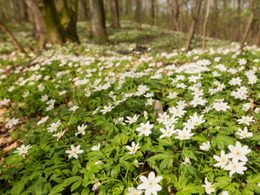
Wood anemones don’t arrive suddenly, rather they spread.
Low to the ground, delicate white petals with soft yellow centres, they form loose constellations across ancient woodland floors. You’ll find them where the canopy is still thin enough to let in spring light, before the trees fully leaf out and shade returns.
They favour old, undisturbed woodland. The kind that feels settled. Rooted. The kind you don’t just pass through, but slow down in.
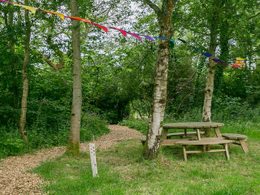
Around Brithdir Mawr, tucked between Bangor and Menai Bridge, this kind of landscape is easy to find. The surrounding lanes, hedgerows and pockets of woodland create ideal conditions for early woodland flowers, and what begins as a scattering in April becomes drifts of anemones beneath the trees as May settles in.
They’re easily mistaken for other white spring blooms but look closely: each flower sits alone on its stem, petals slightly uneven, as if caught mid-movement. They close in dull weather and open fully in the sun, a small but telling detail.
There’s a folklore to them, too. Once believed to be windflowers, said to only open when the wind blew, they’ve long been tied to the turning of the season.
Back at Brithdir Mawr, that same softness carries on.
The farmhouse sits within a landscape that feels alive in spring: birds moving through the trees, bees beginning to return, marshland waking up again.
And after a woodland wander, it’s exactly what you want to come back to. A kitchen that invites unhurried cooking, rooms that feel settled and warm, and an atmosphere that makes you feel like you’ve stepped slightly out of time.
Wild garlic and river valleys: Bwthyn Ysgubor
Before you see it, you’ll smell it.
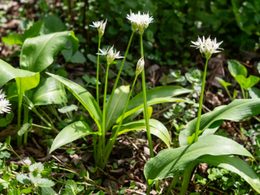
Wild garlic announces itself in the air first, an unmistakable scent that drifts along woodland paths and riverbanks through spring. Follow it, and you’ll soon find broad green leaves and clusters of small, star-shaped white flowers spreading across the ground in great, unruly swathes.
Also known as ramsons, wild garlic thrives in damp, shady places: riverbanks, valley woods, anywhere the soil stays rich and moist. By May, it’s often at its most abundant, carpeting the ground in a way that feels almost deliberate.
The Conwy Valley is one of the best places to find it.
Near Bwthyn Ysgubor, the river winds slowly through pasture and woodland, creating exactly the conditions wild garlic loves. By May, the valley floor and wooded edges is filled with it – bright, fragrant, and impossible to ignore.
It’s popular with foragers, though care is needed. Its leaves can be confused with lily of the valley, which is toxic, but crush a leaf and the garlic scent is immediate and unmistakable.
There’s something deeply satisfying about walking through it. The scent, the sound of the river, the sense that everything is growing again all at once.
Back at Bwthyn Ysgubor, spring doesn’t stop at the gate.
The walled garden becomes part of the experience – fruit trees beginning to blossom and bees drifting lazily between flowers.
Inside, the house is light-filled and calm, designed to make the most of its setting. After a morning in the valley, you might find yourself back in the kitchen with something simple on the go, or sinking into the bath upstairs with views stretching out across the landscape you’ve just walked through.
Yellow archangel and forest edges: Ty Siam
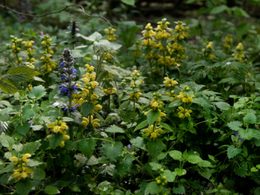
Less well known, but no less striking, yellow archangel appears from spring into early summer, bringing flashes of soft yellow to woodland edges and hedgerows.
Its flowers are delicate, almost orchid-like, clustered along upright stems above textured leaves that often carry a subtle silver pattern. It favours dappled shade, not deep woodland, but the edges of it, where light filters through.
You’ll often find it weaving through mixed landscapes: woodland thinning into open ground, paths edged with hedgerow, places where wild and managed land meet.
Around Newborough and the edges of Coedwig Niwbwrch (Newborough Forest), near Ty Siam, these conditions come together beautifully.
Here, late spring feels expansive. Forest tracks soften underfoot, light filters through Corsican pines, and pockets of wildflowers, including archangel, appear along the margins. Beyond the trees, the landscape opens out towards dunes and sea, giving the whole area a sense of space and movement.
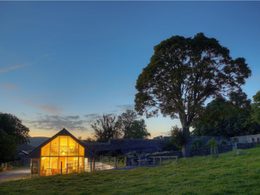
Ty Siam is perfectly placed within this landscape. Set in open countryside but close to forest and coast, it gives you options – morning walks through woodland, afternoons by the sea, evenings spent outside as the light stretches on.
The house itself is made for that rhythm. A large open-plan living space for gathering, a kitchen that encourages proper cooking, and gardens that come into their own in warmer months.
You can return from a walk, leave boots in the porch, and drift straight into the garden. Dinner outside, perhaps, as the air cools slightly. Or a drink by the firepit as dusk settles.

A Season Worth Seeking Out
The magic of late spring is in the small things. The flowers, the light, the sense of everything starting again. Pair a good walk with the right place to stay, and it turns into something you’ll want to come back to every year.